
About Montessori Education
What Is Montessori Education?
A child-led approach that supports development from birth to adulthood, taught by guides trained to the standards of the Association Montessori Internationale.
What Is the Montessori Method?
Montessori education builds a child's capability to become a fulfilled and productive adult able to contribute to the world, at home, at work, and in their community. Maria Montessori's observation of human development from birth to adulthood led to an education approach that supports children's natural development, providing the skills and support to reach their full potential in life. With a strong emotional, behavioural, and moral foundation, children become motivated, active, and independent learners who are prepared for the real world.
Whatever the age group, the same principles are at work:
- The child leads. Children choose their own work from what the environment offers, rather than following one lesson set for everyone.
- The environment teaches. Materials are prepared, ordered and within reach, so a child can work without waiting for an adult.
- Learning happens through the hand. Concepts are met first as concrete material and only later as abstraction.
- Time is protected. Long uninterrupted work periods let concentration build instead of being broken by a timetable.
- Ages are mixed. Three-year age groupings let children learn from and teach each other.
- The adult observes. The guide watches before intervening, and steps in to connect a child with work rather than to correct them.
Education should no longer be mostly imparting of knowledge, but must take a new path, seeking the release of human potentialities.
Maria Montessori, Education for the New World, p.1
How Montessori Works in the Classroom
A unique and engaging learning environment
Unlike traditional classrooms, Montessori learning environments are designed to fit the specific needs of each child's stage of development. Learning is all about the activity and independence of the child to find out what they need at each particular moment.
Everything in the room has its place and its purpose. Materials sit on open shelves in sequence, from simple to complex, and most carry a built-in control of error, so a child can see for themselves whether the work came out right instead of waiting to be marked.
Montessori teachers guide children through discovery
Montessori teachers are experts in child development, guiding children to learn independently and reach their unique potential. Children have the freedom to engage in their own learning experience and the Montessori teacher is there to support the child throughout this process.
This is why Montessori adults are called guides. Their training, which at AMI level takes an academic year or more, is as much about observing children as about presenting materials.

The Four Planes of Development
Montessori describes childhood as four six-year stages, each with its own needs. The environment, the materials and the adult's role all change from one plane to the next, which is why Montessori training is always taken for a specific age group. In practice the first plane is served in two settings, giving the four groups below.
0 to 3
First plane · the absorbent mind
In the first three years the child builds themselves: movement, language, independence and order are taken in directly from the surroundings. A Montessori infant community is prepared for exactly that, with real objects, low furniture and an adult who intervenes as little as possible.
3 to 6
First plane · the Children's House
The same absorbent mind now works consciously. Children refine the senses, meet writing and reading, and take on the care of the environment and of each other. This is the classic Children's House, with its practical life, sensorial, language and mathematics areas.
6 to 12
Second plane · the reasoning mind
The child moves from absorbing to questioning, wants to know why and how, works in groups and cares intensely about fairness. Study opens out into what Montessori called cosmic education, where every subject is met as part of one connected whole.
12 to 18
Third plane · the social newborn
Adolescence brings a second period of rapid change, physical and emotional. The need shifts towards meaningful work, real responsibility and a place in a community, which is why Montessori adolescent programmes are built around genuine practical undertakings.
A fourth plane, 18 to 24, completes the picture: the young adult takes their place in society as an economically independent person. There is also a combined 0-6 orientation course for anyone working across the whole first plane, a course for school leaders and administrators, and short workshops on single topics for every age group.
How Montessori Differs from Traditional Education
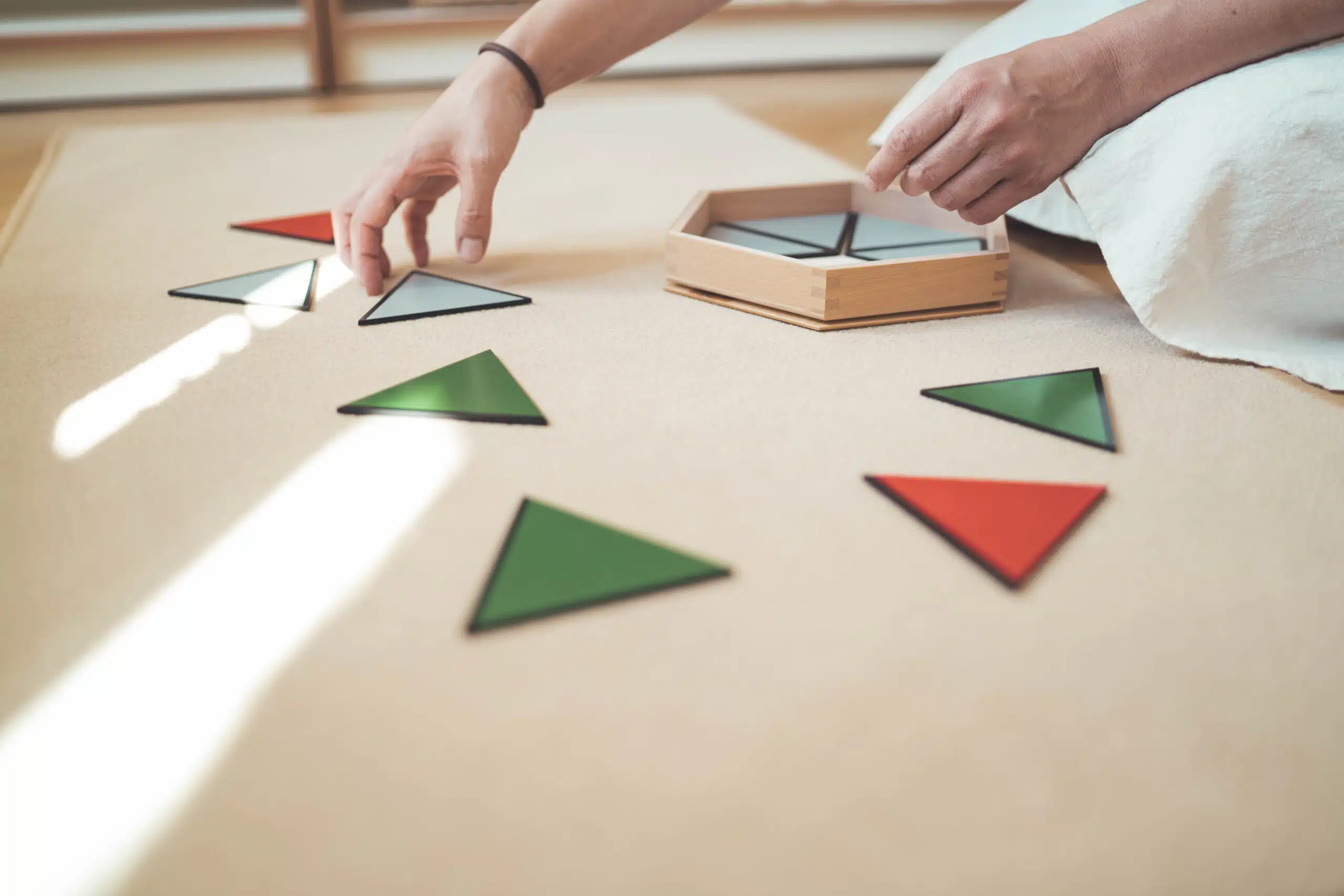
The difference is not a matter of atmosphere or of being stricter or gentler. It is structural: who decides what a child works on, and how the adult spends their attention.
- Children choose their work within a prepared range, rather than all doing the same task at once.
- Classes span three years of age, rather than being grouped by a single birth year.
- Work periods run for hours without interruption, rather than being cut into lesson slots.
- Materials give the feedback, so learning is not driven by grades or comparison with others.
- The adult observes and connects children to work, rather than delivering the same lesson to the room.
What children gain from it
The Montessori approach provides children with enduring intellectual capabilities, achieved through the framework of social and emotional learning. Montessori develops the whole child. Academics and knowledge-building are key qualities of Montessori, as is the ability to think creatively and understand the needs of others. When these fundamental skills are fostered early in life, children gain the capability to problem solve, persevere, and interact well with others in any circumstance.
Who Decides What Counts as Montessori?
The name Montessori is not legally protected, so any school or product can use it. What distinguishes authentic practice is the training behind it. The Association Montessori Internationale (AMI), founded by Maria Montessori herself in 1929, maintains the standards for training and practice worldwide, and Montessori Institute Prague works in alignment with them.
If you are weighing up a school or a course, that distinction is the practical thing to look at. What AMI Montessori means covers the standards themselves, and what to look for.
Join Our Montessori Community
Montessori Institute Prague brings together guides, assistants, school leaders and parents from across Europe and beyond. Leave us your name and we will send you our brochure and keep you posted on what is opening next, whether that is a course, a workshop or a mentoring group.
Frequently Asked Questions
What is Montessori education?
Montessori education is an approach developed by Dr. Maria Montessori from her observation of how children develop. Children choose purposeful work from a prepared environment and learn through their own activity, guided by an adult trained to observe rather than direct.
What is the Montessori method?
The method is the practical form that approach takes: a prepared environment, specially designed materials arranged from simple to complex, long uninterrupted work periods, mixed-age classes and a trained guide who connects each child with the work they are ready for.
What age is Montessori for?
From birth to eighteen, and in principle to twenty-four. Montessori describes four six-year planes of development: 0-6, 6-12, 12-18 and 18-24. In practice most settings serve 0-3, 3-6, 6-12 and 12-18.
What is a prepared environment?
A room organised so that a child can work independently in it. Materials sit in sequence on open shelves within reach, furniture fits the child, and most materials carry a control of error so the child can check their own work.
What are sensitive periods?
Sensitive periods are windows in early childhood when a child is drawn to acquire a particular capacity, such as language, order, movement or refinement of the senses. Work met during that window is absorbed with ease that does not return later in the same way.
What is a Montessori guide?
The trained adult in a Montessori environment. The title reflects the role: preparing the environment, observing each child, and presenting materials at the moment a child is ready, rather than teaching the same lesson to the whole group.
What are the benefits of a Montessori education?
Children develop independence, sustained concentration and the habit of working from their own motivation rather than for marks. Because classes are mixed-age and work is chosen, children also practise cooperation, responsibility and care for others alongside academic work.
What does Montessori ask of families?
Mainly patience with a different measure of progress. Progress shows as concentration, independence and care for the environment before it shows as worksheets or grades, and the approach works best when home supports the same independence.
How do I train as a Montessori guide?
Through an AMI training course for a specific age group: 0-3, 3-6, 6-12 or 12-18. An orientation course gives the foundations and suits assistants and parents, while an AMI diploma course is the full qualification for working as a guide.
Thinking about training in Montessori?
Montessori Institute Prague runs AMI-aligned training for every age group, from orientation courses for assistants and parents to full diploma courses for guides, plus refresher programs and mentoring for people already in the classroom.
Join the community
Leave your name and email and we will send you the Montessori Institute Prague brochure.